From Nigeria’s political capital to its commercial powerhouse, the United States is building a new diplomatic campus in Lagos that is larger in site area and significantly more expensive than the $162 million Abuja embassy-office project completed in 2014. Here is what the two facilities reveal about the changing scale of U.S.–Nigeria engagement.
LAGOS — At first glance, the difference between the United States diplomatic facilities in Abuja and Lagos may appear to be simply a matter of location. One sits in Nigeria’s political capital; the other is rising in the country’s commercial capital.
But the figures tell a much bigger story.
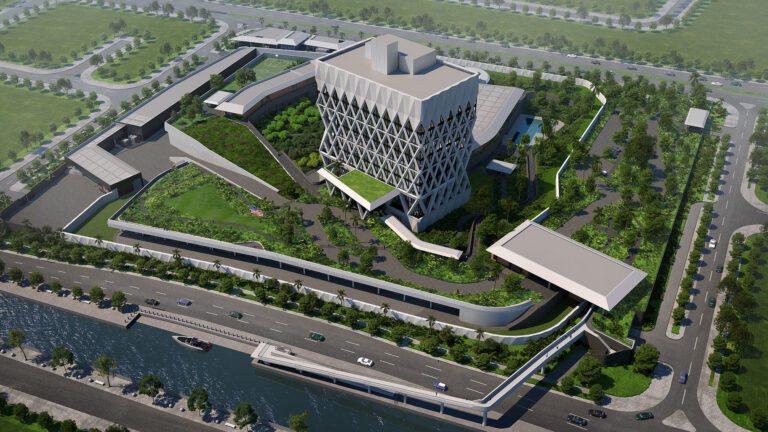
The United States is investing hundreds of millions of dollars in a new Consulate General complex at Eko Atlantic City, Lagos, creating a modern diplomatic campus designed to support consular operations, commercial engagement and broader U.S.–Nigeria relations.
The project, whose groundbreaking ceremony was held on March 31, 2022, occupies a 12.2-acre site at Eko Atlantic. The current U.S. Department of State project page puts its budget at $611 million, with completion estimated for 2028.
That compares with the $162 million project for the new U.S. Embassy Office Annex in Abuja, which was dedicated in November 2014.
The contrast is striking: the Lagos project has a current stated budget roughly 3.8 times the Abuja office-annex project’s $162 million budget.
ABUJA: THE DIPLOMATIC POWER CENTRE

Abuja became Nigeria’s capital in 1991 and is home to the Federal Government, National Assembly, diplomatic missions and the country’s principal political institutions.
It was therefore natural for the United States to maintain its embassy headquarters there.
The Abuja development completed in 2014 was not merely an ordinary office building. According to the U.S. Department of State, the $162 million project included a new Office Annex, a U.S. Marine Security Guard residence, a support annex, parking and community facilities.
The facilities were designed to provide American diplomatic personnel with a secure and modern working environment.
The project also incorporated sustainability measures, including photovoltaic panels, LED lighting, water-saving plumbing fixtures and measures designed to reduce heat gain.
The United States formally dedicated the new Office Annex on November 7, 2014.
THEN CAME LAGOS
Eight years after the Abuja facility was dedicated, the United States began construction of another major diplomatic facility—this time in Lagos.
On March 31, 2022, U.S. and Nigerian officials gathered at Eko Atlantic for the groundbreaking ceremony of the new U.S. Consulate General.
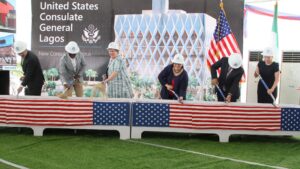
The choice of Lagos was significant.
While Abuja is the centre of Nigeria’s federal government, Lagos remains the country’s largest city and a major centre for commerce, finance, technology, trade and investment.
The U.S. State Department describes Lagos as a major economic hub and says the new consulate will provide a platform for engagement in areas including trade, investment and innovation.
A 12.2-ACRE DIPLOMATIC CAMPUS
The scale of the Lagos development is considerable.
The new Consulate General occupies 12.2 acres at Eko Atlantic and is being developed as a campus rather than simply a single office structure.
According to the U.S. Department of State, the development includes the principal consular facility as well as a warehouse, vehicle-maintenance building, Marine Security Guard residence, utility buildings, two parking garages and three compound-access-control buildings.
The project is also being designed around resilience and energy efficiency.
The State Department says the development will use measures intended to reduce energy demand and operating costs, while landscaping will help with cooling and stormwater management. Its location within Eko Atlantic also gives the project access to the development’s modern infrastructure, including its major seawall.
$611 MILLION: WHY THE NUMBER MATTERS
One of the most frequently quoted figures surrounding the Lagos project has been $537 million.
However, the current U.S. Department of State Bureau of Overseas Buildings Operations project page lists the Lagos project budget at $611 million.
That distinction matters for anyone publishing the figures today.
The $611 million figure represents the current project budget listed by the U.S. government, while the earlier design-build contract announced in 2021 was $319 million. The contract value and the overall project budget are therefore not the same thing.
2,500 NIGERIANS AND $95 MILLION LOCAL INVESTMENT
Beyond the physical structure, the project is expected to have a significant economic footprint.
The U.S. State Department says approximately 2,500 Nigerian citizens are expected to work on the project, including engineers, architects, artisans, construction workers and administrative staff.
It also estimates that approximately $95 million will be invested in the Nigerian local economy through local subcontractors and suppliers.
The project is therefore not only about American diplomatic infrastructure; it is also a sizeable construction and local-economic undertaking in Lagos.
ABUJA VS. LAGOS: THE NUMBERS
| U.S. Embassy/Office Annex, Abuja | New U.S. Consulate General, Lagos | |
|---|---|---|
| Location | Abuja | Eko Atlantic, Lagos |
| Diplomatic role | Embassy complex/office annex | Consulate General |
| Project budget | $162 million | $611 million current budget |
| Site | Abuja diplomatic complex | 12.2 acres |
| Major milestone | Dedicated Nov. 7, 2014 | Groundbreaking Mar. 31, 2022 |
| Estimated completion | Completed | 2028 |
| Local economic investment | — | $95 million estimated |
| Nigerian workers | Substantial local participation | Approximately 2,500 |
| Major components | Office annex, security, support and community facilities | Consular facility, residence, warehouse, utility, maintenance, parking and security facilities |
The comparison should be understood carefully: the $162 million Abuja figure refers specifically to the 2014 Office Annex project, rather than a claim that the entire U.S. Embassy compound was constructed for $162 million.
WHY EKO ATLANTIC?
The Lagos project is being built in an environment deliberately designed as a new urban and commercial district.
Eko Atlantic is located on reclaimed land along Victoria Island and incorporates major infrastructure, including an approximately 8.5-kilometre seawall designed to protect the development from coastal erosion and rising sea levels.
For the United States, the location places the consulate within one of Lagos’ emerging business districts while providing the infrastructure needed for a large, secure diplomatic campus.
The State Department explicitly links the Lagos mission to economic engagement, identifying trade, investment and innovation among the areas the new facility is expected to support.
NOT A REPLACEMENT FOR THE EMBASSY IN ABUJA
Perhaps the most important point is that the Lagos project does not mean the United States is moving its embassy from Abuja to Lagos.
The U.S. maintains its Embassy in Abuja and Consulate General in Lagos as separate diplomatic missions serving different functions. The U.S. government’s current travel information continues to list both facilities.
The distinction is important.
An embassy represents the United States to the government of the host country and is headed by an ambassador. A consulate general focuses substantially on consular services and engagement within its area, while also supporting broader diplomatic and economic relationships.
THE BIGGER PICTURE
The Abuja and Lagos projects reflect two different dimensions of America’s relationship with Nigeria.
Abuja represents political and governmental engagement.
Lagos represents commercial, economic and consular engagement.
The new Lagos facility is also being designed with contemporary security, environmental and resilience requirements. The U.S. State Department says the campus will incorporate American and Nigerian contemporary artwork, creating a cultural dimension alongside its diplomatic purpose.
When completed, the Eko Atlantic facility will therefore be more than another office complex on the Lagos skyline.
It will be a major physical representation of the United States in Nigeria’s economic capital—built on a 12.2-acre site, backed by a current $611 million project budget, and expected to be completed in 2028.
From Abuja’s diplomatic corridors to Lagos’ commercial skyline, the American diplomatic footprint in Nigeria is expanding in two distinct directions—political and economic.
All project figures in this report are based primarily on U.S. Department of State sources. The Lagos project’s current official budget is $611 million; earlier reports and project announcements cited lower figures, including a $319 million design-build contract.
About the Author