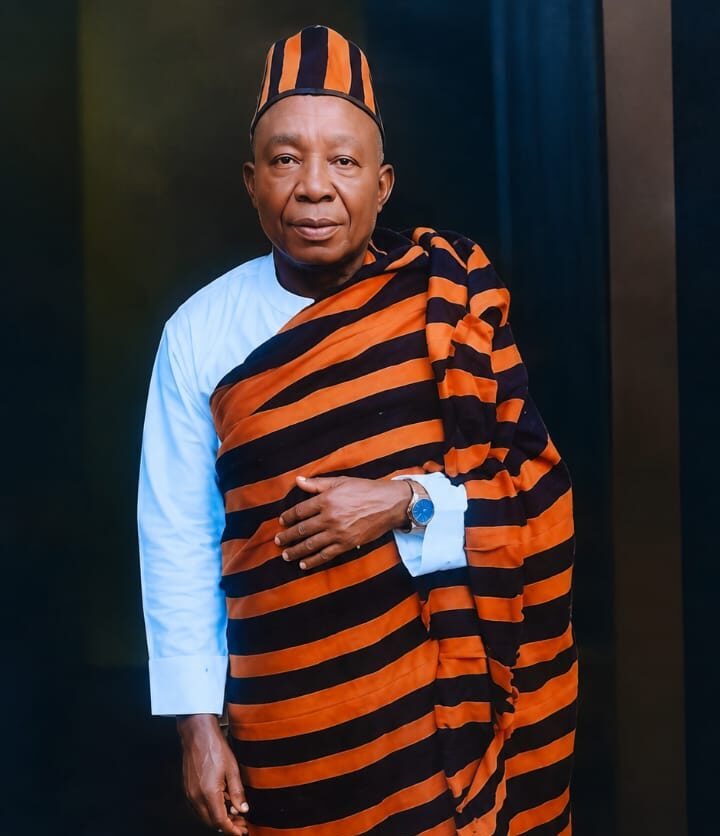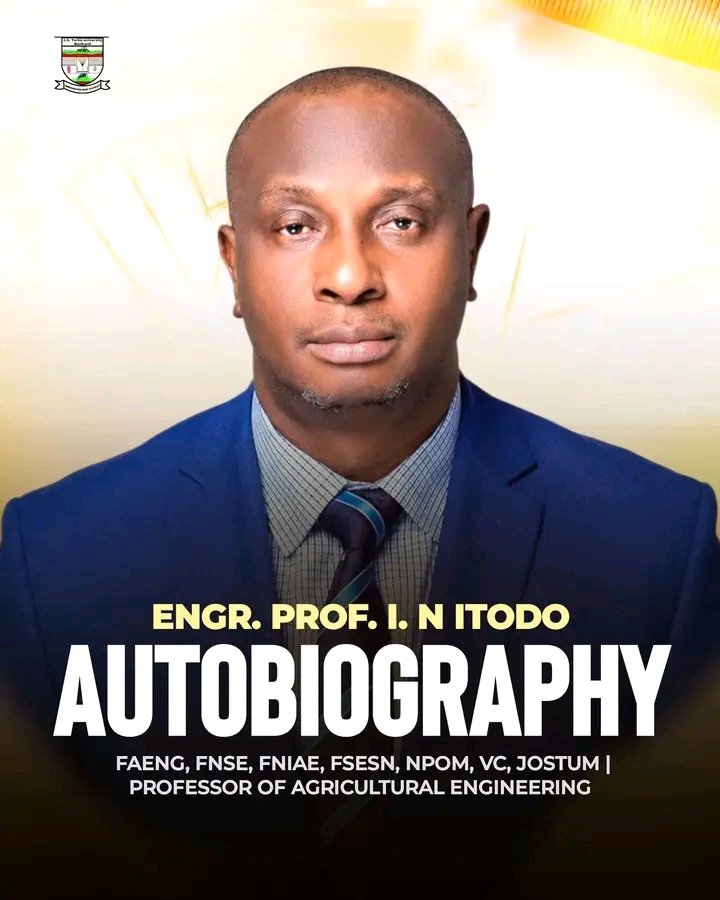
My name is Isaac Nathaniel Itodo.
When I look back at the journey of my life, I see much more than academic degrees, professional titles, appointments and recognitions. I see a long journey of learning, service, relationships, responsibilities, opportunities and, above all, purpose.
I was born in Abeokuta, Ogun State, Nigeria, but my childhood was spent across different parts of Nigeria. Between 1968 and 1975, I attended primary schools in Kano, Sokoto, Afikpo, Abakaliki, Enugu and Kaduna.
Moving from one place to another at such an early age exposed me to different people, cultures and ways of life. I did not know it then, but those experiences were preparing me for a life that would itself be defined by movement, diversity and service to people and institutions.
In 1976, I came to Makurdi to attend Mount Saint Gabriel’s Secondary School, where I studied until 1981. That institution became an important part of my formative years and would remain connected to my story many decades later.
My interest in engineering eventually led me to the University of Jos, ( Makurdi Campus, now JoSTUM) , where I obtained my Bachelor of Engineering degree in Agricultural Engineering in 1986. I proceeded to obtain a Master of Science degree in 1989 and a Doctor of Philosophy degree in December 1993 at the University of Ibadan.
Those years taught me an important lesson: education is not simply about acquiring certificates. It is about developing the capacity to understand problems, ask questions, find solutions and contribute meaningfully to society.
THE BEGINNING OF MY ACADEMIC LIFE
In 1987, I began my academic career as a Graduate Assistant in the Department of Agricultural Engineering at the University of Jos.
I was beginning a journey that would eventually span almost four decades.
I grew through the academic ranks and became a Professor in October 2003. Along the way, I had the privilege of serving in various academic and administrative capacities.
I served as Head of the Department of Agricultural Engineering from 1996 to 2000, Deputy Dean from 2001 to 2002 and Dean of the College of Engineering from 2005 to 2008.
I served as Editor of the Journal of Agriculture, Science and Technology and as Hall Adviser of Hostel D. I later became Programme Leader for Technology and Environment at the Institute of Food Security and subsequently served as Director of Linkages.
Each responsibility introduced me to a different dimension of academic leadership.
I learnt that universities are not merely buildings, lecture theatres and laboratories. They are communities of people, ideas and aspirations. Their greatest strength lies in the people they develop and the knowledge they generate.
LEARNING TO SERVE
My involvement in university administration grew over the years.
I served on the Governing Council of the university and chaired or participated in several committees, including the University Corporate Image Committee, the Public and Inaugural Lecture Committee and the University Sports Committee.
I coordinated the UAM/NNPC Automotive Ethanol Biomass Programme for more than a decade and served as Chairman of the Pope John Paul II Catholic Chaplaincy.
In 2014, I received the Outstanding Service Award of the University of Agriculture, Makurdi.
These experiences taught me that leadership is ultimately about service.
Every office comes with authority, but more importantly, it comes with responsibility. The higher one rises, the greater the obligation to listen, to serve and to create opportunities for others.
RESEARCH AND THE PEOPLE BEHIND THE NUMBERS
As an academic, I have always considered teaching, research and mentorship inseparable.
I have supervised more than fifty undergraduate projects, twenty-five postgraduate diploma projects, twenty-one Master of Engineering theses and twelve PhD theses.
I have had the privilege of watching students who once came to me for supervision grow into accomplished academics and professionals. Eight of my former postgraduate students are now Professors.
For me, that is one of the most meaningful measures of an academic career.
A publication may be cited. A building may carry a name. An award may be displayed on a wall. But when a student becomes a professor, a researcher, an engineer, a leader or simply a better human being because of the knowledge and encouragement received, something much more enduring has been achieved.
I have also served as an editor or member of the editorial boards of several learned societies and university journals and have mentored young researchers through programmes such as the SEED Programme of the Nigerian Academy of Science.
ENGINEERING, INNOVATION AND RENEWABLE ENERGY
My professional interests have taken me beyond the conventional boundaries of Agricultural Engineering.
Renewable energy has been a particularly important part of my work.
I received a Kassel University, Germany scholarship in 2011 to participate in the International Solar Energy Society Solar World Congress. I subsequently served as President of the Solar Energy Society of Nigeria from 2016 to 2019 and remain a Life Member of the society. I currently serve as Chairman of its Board of Trustees.
My work has also involved biofuels, biomass and energy systems. I participated in technical committees responsible for developing Nigeria’s biofuels training manual and standards for biofuels production.
I have served as a consultant and committee member on renewable energy initiatives and continue to contribute to conversations around sustainable energy and development.
I hold two Nigerian patents: one for a yam-in-mound harvesting machine and another for an improved acha dehulling machine.
These innovations reflect something I have always believed: knowledge should not remain confined to books and laboratories. It should ultimately solve problems.
CONTRIBUTING BEYOND MY UNIVERSITY
My academic service has taken me into many Nigerian universities and professional institutions.
I have served on COREN and NUC accreditation committees involving twenty-three universities. I have examined postgraduate candidates across nine universities and assessed candidates from seventeen universities for promotion to the rank of Professor.
I have contributed to the development of academic programmes and institutions, including work associated with the establishment of faculties and programmes at Benue State University.
I have also served as an External Assessor in the appointment of Vice-Chancellors of Nigerian universities.
In 2021, I was appointed Chairman of the Presidential Visitation Panel to the Federal University, Gusau.
These assignments have allowed me to see higher education from different perspectives and have strengthened my conviction that the quality of a nation’s future is closely connected to the quality of its educational institutions.
PROFESSIONAL SERVICE
Over the years, I have served in various capacities within the engineering profession.
I was Chief Examiner for Agricultural Engineering at the Makurdi Zonal Office of COREN from 2002 to 2012 and later served as an Engineering Regulation and Monitoring Inspector.
I served as Technical Secretary of the Committee of Deans of Engineering and Technology of Nigerian Universities and participated in committees of the Nigerian Society of Engineers dealing with engineering education, professional practice and graduate internship.
Since 2021, I have served as Chairman of the Agricultural Engineering Curriculum Review Committee of the Nigerian Institution of Agricultural Engineers.
I am also Vice Chairman of the Agriculture Committee and a member of the Membership Committee of the Nigerian Academy of Engineering.
Professional service has taught me that no discipline develops in isolation. Progress comes when individuals and institutions are willing to contribute their knowledge to a collective purpose.
THE INTERNATIONAL DIMENSION
My work has also taken me beyond Nigeria.
Between 1997 and 1998, I served as Team Lead and Consultant to the United Nations Development Programme (UNDP).
I have presented papers and participated in academic and professional conferences in South Africa, the United States, Germany, the Republic of Benin and Canada, among other countries.
I have attended more than 108 national and international conferences and workshops and presented 46 papers as Keynote, Guest or Lead Speaker.
These experiences have broadened my understanding of the world and reinforced my belief that Nigerian academics and professionals have a responsibility to contribute to global knowledge while remaining committed to solving Nigerian problems.
WRITING, RESEARCH AND KNOWLEDGE
I have authored or co-authored 125 publications.
I am the author of Agricultural Energy Technology and Biogas Technology in Nigeria, both published by CRC Press, London.
One of my publications on the effects of biogas fuel in electric generators received the third-best engineering academic publication award in Nigeria in 2019.
But research has never been only about numbers for me.
Behind every research paper is an attempt to understand something better. Behind every experiment is a question. Behind every innovation is a problem waiting for a solution.
I have also maintained a personal relationship with literature and poetry and have published poems in anthologies.
Perhaps that is because engineering and poetry, although seemingly different, both require imagination. One seeks to build solutions; the other seeks to give expression to human experience.
RECOGNITION
Over the years, I have been fortunate to receive professional and national recognition.
I became a Fellow of the Nigerian Society of Engineers in 2009 and a Fellow of the Nigerian Academy of Engineering in 2021. I am also a Fellow of the Solar Energy Society of Nigeria and the Nigerian Institution of Agricultural Engineers.
In 2021, I received the National Productivity Order of Merit, one of Nigeria’s national recognitions for productivity and service.
I have also received the Excellence Award as an Academic Icon in the Engineering Profession from the Nigerian Society of Engineers, Makurdi, and the Distinguished Award of Excellence (Academic) from the University of Agriculture, Makurdi Alumni Association.
In 2007, I was honoured with the traditional Igala title of Commander of the Igala Kingdom by the Igala Cultural and Development Association.
I appreciate every recognition I have received, but I have never regarded an award as the destination.
Recognition is a reminder of the responsibility to continue contributing.
MY JOURNEY TO THE VICE-CHANCELLORSHIP
In February 2023, I was appointed the 7th Vice-Chancellor of Joseph Sarwuan Tarka University, Makurdi.
Becoming Vice-Chancellor was not the beginning of my service to the university. It was another chapter in a journey that had already taken me through teaching, research, administration, professional practice and institutional development.
Leadership at that level demands more than academic credentials.
It requires patience.
It requires listening.
It requires difficult decisions.
It requires the ability to bring different interests together around a common institutional purpose.
Most importantly, it requires understanding that an institution is bigger than any individual who occupies an office.
My responsibility as Vice-Chancellor is therefore not simply to administer an institution. It is to contribute to its growth, strengthen its systems, encourage scholarship, support its people and help create an environment where students and staff can fulfil their potential.
SERVICE BEYOND THE OFFICE
My understanding of service has never been restricted to my professional appointment.
I served as 2nd Vice President of the Conference of Alumni Associations of Nigerian Universities and currently serve as Provost of the Mount Saint Gabriel Old Boys Association.
The latter responsibility has a special meaning for me because Mount Saint Gabriel’s is part of my own story.
To return decades later to serve an institution that contributed to my formation is a reminder of how life often brings us back to places that helped shape us.
I have also served on various national and institutional committees, including the Nigerian Universities Games Association and other bodies concerned with education, engineering, renewable energy and institutional development.
FAMILY
Beyond the titles and responsibilities is a man who is also a husband and father.
I am married to Grace, and we are blessed with a daughter, Iye.
Family provides a different kind of grounding. Public responsibilities may demand one’s time and attention, but family reminds us of the people and relationships that matter beyond our professional identities.
Outside work, I enjoy playing squash, reading and watching football.
These interests provide moments of relaxation and allow me to maintain a balance amid the demands of academic and public service.
WHAT THE JOURNEY HAS TAUGHT ME
My journey has taught me that success is rarely the product of one moment.
It is built gradually.
It is built in classrooms, offices, laboratories, meetings, institutions and relationships.
It is built through opportunities, but also through challenges.
It is built by the people who teach us, those who believe in us, those who challenge us and those who give us opportunities to serve.
I have learnt that positions are temporary, but impact can endure.
I have learnt that knowledge becomes more valuable when it is shared.
I have learnt that leadership is service.
I have learnt that institutions must outlive the individuals who lead them.
And I have learnt that no matter how far one travels, there is always more to learn.
MY CONTINUING JOURNEY
From the young boy who attended schools across different parts of Nigeria, to the student of Mount Saint Gabriel’s, to the engineering student at the University of Ibadan, to the Graduate Assistant who began an academic career in 1987, and eventually to Professor and Vice-Chancellor, my life has been a journey through many seasons.
I have been a student, teacher, researcher, inventor, mentor, administrator, professional, husband, father and servant of institutions.
Each role has shaped me.
Each responsibility has taught me something.
Each opportunity has created another opportunity to serve.
My story is therefore not simply about what I have achieved. It is about what I have been privileged to contribute and, perhaps more importantly, what I am still capable of contributing.
I remain committed to education, engineering, research, renewable energy, mentorship and institutional development.
I remain committed to helping young people discover their abilities and create meaningful futures.
I remain committed to the belief that our universities can become stronger, our professions can become better, and our country can make greater progress when knowledge is matched with integrity, service and purpose.
The journey that began many years ago continues.
And as long as there is still an opportunity to learn, to teach, to lead, to mentor and to serve, there is still work to be done.
— Engr. Prof. Isaac N. Itodo, FAEng, FNSE, FNIAE, FSESN, NPOM
Vice-Chancellor, Joseph Sarwuan Tarka University, Makurdi
About the Author